Ok, time for an update. It has been a while since the last post, and more than a lot has happened.
The summer has been good. Things have gone at least as well as I hoped they would and so far I'm still on my feet. It's time once again for the Blue Hill fair, and I will again have a display in the main Exhibition Hall. It's very exciting, and I am planning the best display of the three I have done so far. Once it is set up, I'll post a picture here.
So, what else have I been up to? Well let's see. I've been throwing, trimming, glazing and firing pots. I have been doing glaze tests by the dozen (more on the search for a Duckshead in a bit), and yes, selling pots.
I'm exhausted, but very happy with the way things have gone so far. Many old Rowantrees customers have been in to talk. It's always great fun to share memories of Rowantrees from all sides. People are glad that the tradition is being carried forward and they have all expressed their approval of the wares I am producing.
Whew!
I had another challenge recently in the form of an order for something I had not yet produced. Last year it was a large tea pot. This year, it was a small tea pot. Tea pots are probably the most difficult form for the potter because each is made up of three separate pots; the pot itself, the lid and the spout. Each is thrown in isolation from the others, but they must be assembled in a way that results in a harmony. If that harmony fails to materialize, the potter has wasted his time.
You be the judge.
That's actually a coffee cup in the picture, not a teacup. But you'd still get two of those out of that pot.
And now, Duckshead. Ah, Duckshead. How I have worked, experimented, tested and oh, how close I have come. Really. I have said it won't be long, and I still believe that. I knew black was a difficult "color" for a glaze, but a black that has to have a metallic luster to it is even more difficult. I am close. So very close.
But glazes have to do a lot of things. Looking good out of the kiln is but one of them. I have had a procession of them that looked great in the initial tests, but didn't suspend well in water, or didn't apply well with the spray gun, or failed to "flow" they way they should, or were too matte, or didn't have the metallic sheen, or...
And that doesn't even include the battery of tests that glazes have to pass before I will pass them for production.
It's coming. Have faith if you are still waiting for it. I do. it will come.
The same is true of Evergreen and Seagull Gray, But Duckshead first.
Saturday, August 27, 2011
Friday, July 22, 2011
The Return of Jonquil Yellow
Customers have a way of keeping me on my toes. Every now and then I wish I could get one step ahead of them, but I think it's better to let them lead on occasion.
So it is with color. I had a plan for the order of things where it came to reformulating the Rowantrees glazes. I would start with the most popular colors and combinations and then work on those that sold less well historically. Some I wouldn't bother with at all for the time being. I set about working on what I think of as the essential palette of Oyster White, Heather Blue, Turquoise, Moss Agate and Ducks Head. I was deep in the Ducks Head process (you can expect an announcement very soon!) when I got a note from a customer asking about Jonquil Yellow.
Yellow? Ok. Jonquil Yellow it is.
To be honest, yellow is not one of my personal favorites, and it never really sold well when I was at Rowantrees. But people did buy it and those who did really loved it. And before I knew it, at least two other people had asked about it.
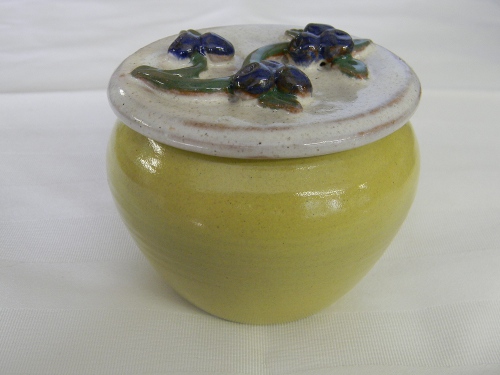
It really didn't take long. In fact, I got a great Yellow out of the first batch of tests. And because it is based on the Oyster White formula, I know already that it will fit the clay body without complaint. So production in Yellow has started. Here is a sample form that first test set.
Make exception for the daylight lighting. There will be far better photography when the next load comes out of the kiln.
So, high on my achievement, I announced to the customers who had asked about it that the Yellow was again available. I haven't heard anything from them as yet,
But three people have since come into the shop to ask if I had anything in Evergreen.
Monday, July 11, 2011
The Recycling Thing
One of the great things about pottery is the fact that so much of the materials we use can be recycled. Of course, that can be a challenge as well.
In late May I took delivery of one ton of clay. I remember wondering if I would be able to use it all before the cold weather sets in. I didn't want to have to lug too much clay home, sut I would do that and store it in the cellar to keep it from freezing.
Well, it is now less than two months later and I am down to 700 pounds of the original purchase. Now the angst is generated by wondering if I will have enough clay to get me to the cold weather or if I will have to get more. But in fact, I probably won't. Clay can be recycled!
A lot fo the clay used to throw a pot is trimmed off a few days later. After all, pots have a top side and an underneath. Ever wonder how the bottom of a pot happens? Pots are dried until they are stiff - 'leather hard' is the term most potters use. Once they reach that stage, pots can be turned over, placed back on the wheel and their undersides carved with special tools to make the "foot". Of course, that results in trimming scrap.
Lots of it. And all of it reclaimable. I have gone low tech with this and decided to use a simple method. Clay always seems better to me when it has been reduced to a slurry for reprocessing. So trimming scrap is mixed with water to the consistency of yogurt. I mix the slurry using a drill mixer until it is smooth and then pour it into an evaporation table. The table is about 2 feet by four feet and has a plaster tub for a top.
Or at least, it will when I'm finished building it. Here it is as it currently stands:
This was today's project. In a couple of days, I will mix plaster and pour a tub top. The plaster surface will be covered with duck canvas, and the clay slurry will be poured into the canvas-lined tub. After a few days, the clay can be cut into bricks and set out to stiffen a little more before pugging and storing. That should keep me in clay for the rest of the season. It may even give me sufficient to work at home over the winter.
Maybe...
Sunday, July 3, 2011
Open Sesame!
The shop is now open. During July and August, I will be open two weekdays each week as well as Saturdays, afternoons and by appointment. I will be posting a detailed schedule soon, so check back! For starters, I will be in the shop on July 4th. Have a wonderful holiday everyone!
Oh! And I finally came up with a logo for my business. Here is it:
This image is my rendition of a Mountain Ash tree. Since I make reproductions of Rowantrees Pottery, I decided to use an image of a Rowan or European Mountain Ash. I chose a folk art style to represent the New England simplicity that Rowantrees embodied. As of this writing, I am now working on a sign to put out in front of the shop.
Busy, busy, busy!
What a Difference a Clay Makes!
Well, the change to a new clay has proven to be an incredibly good decision. Let's see if I can remember all of this off the top of my head...
In only four weeks of production, I have thrown:
60 Jam Jar Lids
114 Jam Jars
50 Jumbo Mugs
50 Coffee Mugs
60 Cocoa Mugs
100 small Saucers
30 Dinner Plates
30 Luncheon Plates
80 Bud Vases
12 small Cream and Sugar Sets
24 large Cream and Sugar Sets
12 large Covered Baking Dishes
50 Bread & Butter Plates
12 Butter Covers
30 Chowder Cups & Saucers
50 Ramekins
12 Pasta Bowls (Actually, I made more than that but had to throw some out)
If I wasn't so excited about this, I'd be exhausted. But it's amazing what you can do if you don't have to focus any energy on fighting with your raw materials.
Well, for the most part.
A new clay carries a few surprises with it.The process of discover and recover goes on, but the issues that arise are not unfamiliar ones to any potter.
In addition to the activity at the pottery itself, I have been moving forward with tile project at home. Here is a picture of a small run of the Portland Head Light tiles. They have been coated with a thin layer of white slip (called an engobe) that will make decorating them easier. They aren't in production just yet, but it won't be long. I have come a long way with them but there is a ways to go.
Wednesday, June 1, 2011
The Clay Has Arrived!
Well, it was two weeks later than expected, but the clay finally arrived. One ton - 2000 pounds - sitting in the driveway when I got to the pottery after work last Thursday. One ton of clay doesn't take up a lot of square footage. It looked pretty small sitting there, piled three boxes high in places, sitting on a palette and wrapped in that extra sticky plastic that keeps loads from shifting in the back of a delivery truck. But trust me when I say that there was a lot of clay.
To get it inside, I had to unstack it in the driveway first. The floor in the clay room tends to be damp, so putting the boxes directly on the floor would be a bad idea. That meant getting the palette out from under the stack. I haven't been in the gym for a month, so the exercise seemed like a good idea. I took great care to use mu legs rather then my back in lifting. Even though it's only fifty pounds at a time, it's a lot of fifty-pound lifts - specifically 40 of them - to get to one ton. The boxes were stacked a few feet over from the original pile, then I took the palette in and found a good spot for it in the clay room. Two ramps, one wheelbarrow and twenty trips later, all that clay was sitting indoors right by the pug mill.
Then I started reminiscing.
I had cleaned the pug mill out very carefully to avoid mixing any old clay in with the new. A little mixing is inevitable given that this particular machine has been in operation since the 1940s. It was built by the Crosley Machine Company of Trenton, NJ, which no longer exists. But they built this beast to last a very long time and with very little maintenance, it has done just that. Come the day that I move into my own digs, I won't be able to take this machine with me because its footprint is too big and I won't have the required three-phase power to run its motor. I will dearly miss it.
They built machines to last back when Rowantrees was first getting started. Still in residence at the pottery are the original filter press and pug mill from Crosley. The pug mill is still going strong, its huge 5 hp motor purring like a kitten and its gears meshing as well now as they ever did. You don't find many like them in the world these days.
The flywheel on the mill at Rowantrees is a lot larger than this illustration, and there is no clutch, but materially it is the same machine. The barrel holds about 150 pounds of clay and I would estimate its output at a good 600 pounds an hour (Crosely said 1 ton per day).
It has never broken down. Not once. Never. It requires grease from time to time, but that's it.
The filter press has had a somewhat more troubled past, but it has a lot more moving parts. And really, it's the pump that had most of the problems. Most of those problems stemmed from the fact that those of us using it on a regular basis were not machinists and consequently didn't quite know how to relate to it. So a small leak around the piston packing got fixed by putting in more packing. The occasional pebble that made it through the screening process might cause a valve to stick open. And the blankets could get creased easily, which would lead to a high-pressure spray of clay that could hit ceiling and windows before anyone knew what was going on. It led a merry chase now and then, but was generally faithful to its mission. I can still hear it's gentle whirr and thumping noises as the giant piston moved clay slip out of the tank and into the press. A few minutes of that would be followed by the sound of rain as water started raining and then dripping from the blankets. Three hours of that, and the clay cakes inside were usually ready for pugging and storage.
A tank beneath the press caught the excess water, which would be pumped back into the mixing tank and recycled for the next batch of clay. This illustration does not feature some options that the Rowantrees press has, like a relief valve that maintained a steady pressure of 80 psi.
Usually. It was a valve. Pebbles, you know.
The last time I used the press was probably sometime in 2008. I recall running a couple batches of clay through it without any fuss. But it has sat dormant ever since. By now the piping and valves are probably encased in dry clay. To operate the press now would require me to disassemble it, clean it and rebuild it. Time does not permit.
Rowantrees used local clay that usually came from local contractors. When I first arrived in Blue Hill, the clay supply had come from a local school construction project. It was unearthed when the foundation hole was dug. The problem with clay like that is that it is mixed with rocks, gravel and top soil, all of which has to be removed. Hence this process.
There are other ways of refining local clay that are less machine and labor intensive. They all require using clay that is dug from a much deeper depth and is consequently more pure. The potteries I know of that still use local clay use very pure deposits. Rowantrees never owned its own clay field, so the process is used was necessary.
But when you are a one-person operation, you have to choose how you will spend your time. I can mix and process clay or throw it on my wheel. Given the additional safety issues with mixing and processing clay, I decided long ago to switch to a commercial clay body. There are reasons beyond time in the shop, but I discussed those some time ago in earlier posts.
Despite this change in the traditional Rowantrees process, some continuity remains. The clay I have chosen is manufactured by the Standard Ceramic Supply Company of Pittsburgh, PA. Throughout its history, Rowantrees bought its raw glaze materials from Standard. Now the clay comes from them as well.
I have been throwing since last Friday. So far, I have produced 60 jam jar lids, 116 jam jars, 50 jumbo mugs and 60 cocoa mugs. I trimmed the jam jars today and will start on the large mugs tomorrow. This clay is fantastic to work with and will provide the same deep red color that the local clay did. I am looking forward to further exploration with this stuff.
But for now, I need bisque ware. Off and potting!
Sunday, May 15, 2011
The Clay is Coming!
I ordered a ton of clay a couple weeks ago, and I'm hoping it will arrive sometime this week. That will kick things off.
A ton may sound like a whole lot of clay but believe me, a potter can go through that much pretty quickly. In one year at Rowantrees I threw exactly 11,000 pieces with an average throw weight of about 2 pounds. That would be about 11 tons in one year, so I'm still working small here.
The signs of spring are beginning to show themselves. The weather is warmer - if wet - and with Mother's Day came my first sale of 2011. It was just a bud vase, but there's something emblematic about selling anything after a hiatus of several months.
It helps.
Research and reformulation are still the top priority, but bisque production will need to start up right along with that. But before any of that can happen, a lot of cleaning up is in store. This week, it starts.
Subscribe to:
Posts (Atom)